Hyperactivity Sensing and Family-Centered Support for Children: LemurDx Project
Advisors: Mayank Goel (CMU), Oliver Lindhiem (University of Pittsburgh), Traci M. Kennedy (University of Pittsburgh)
Core Collaborators: Karan Ahuja (Northwestern University), Shreya Bali (CMU)
Period: 2021.8 - Current

Background and Goal
Attention-Deficit Hyperactivity Disorder (ADHD) affects approximately 5% of children and adolescents worldwide [ref]. Children with ADHD often exhibit increased inattentiveness, impulsivity, and hyperactivity, with symptoms appearing as early as four years of age. In school-age children, more than half of ADHD cases involve hyperactivity symptoms [ref]. Current assessment of hyperactivity primarily relies on questionnaires completed by parents or teachers. While convenient, these reports often suffer from low inter-rater reliability and limited contextual awareness [ref]. As a result, clinicians may struggle to accurately evaluate the severity and patterns of hyperactivity in everyday environments. Our research explores how wearable sensing and interactive systems can support both objective measurement and real-time intervention for children with hyperactivity. Through the LemurDx and CalmReminder projects, we investigate how passive sensing can quantify hyperactivity in daily life and how real-time, sensing-based prompts can support caregivers in everyday parenting.
Sensing Approach
Our first step focused on objectively measuring hyperactivity using passive mobile sensing ([J.5] LemurDx). In collaboration with the University of Pittsburgh Medical Center (UPMC), we collected data from 61 children (25 diagnosed with hyperactivity) who wore a smartwatch for up to seven days during their normal routines.
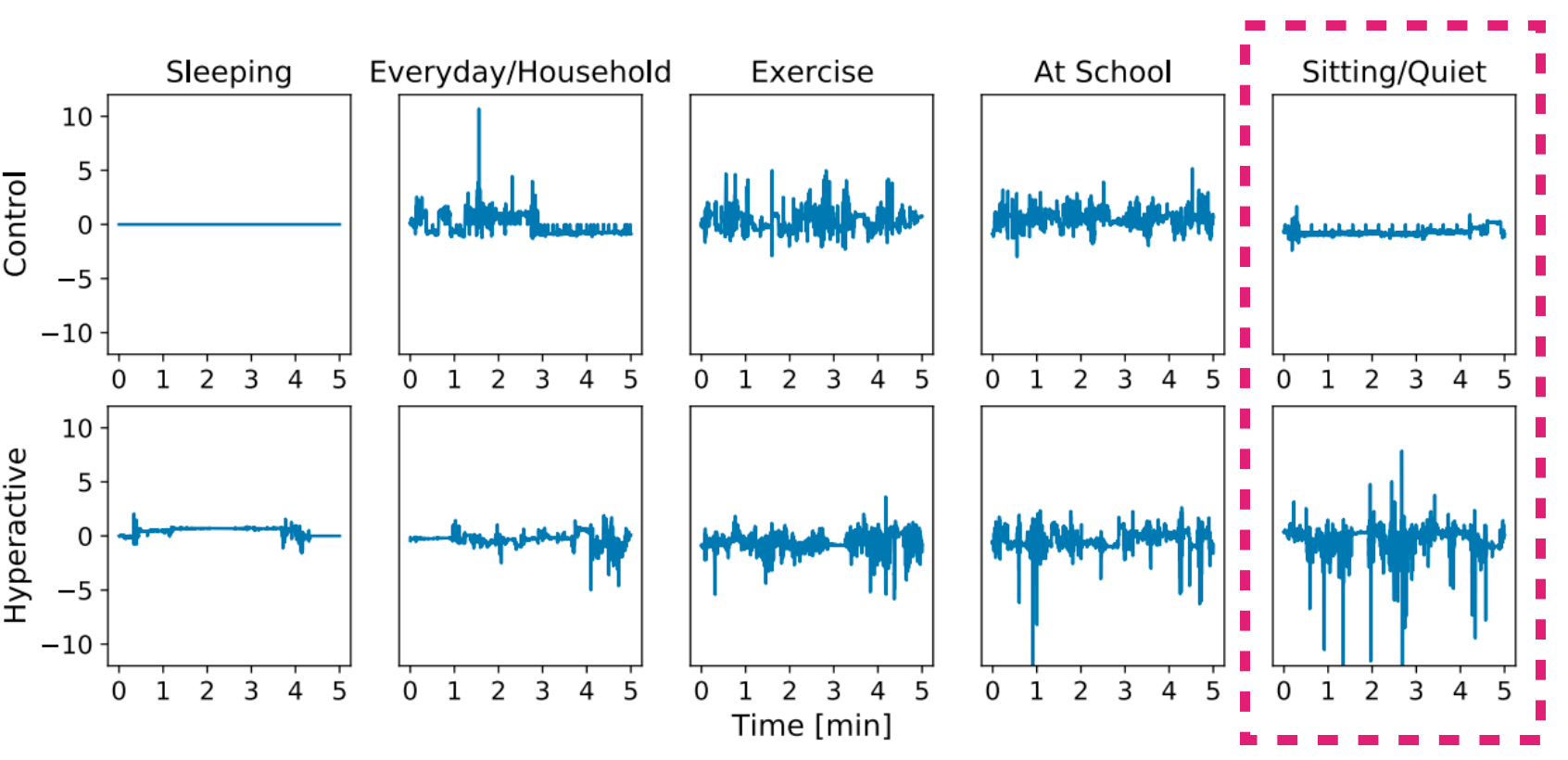
In unconstrained environments, however, raw motion levels alone are insufficient to assess hyperactivity: large movements while reading may indicate dysregulation, while similar movements during outdoor play may be expected. To address this contextual uncertainty, LemurDx first estimates the child's activity context from multimodal sensor signals and then interprets motion within that context.
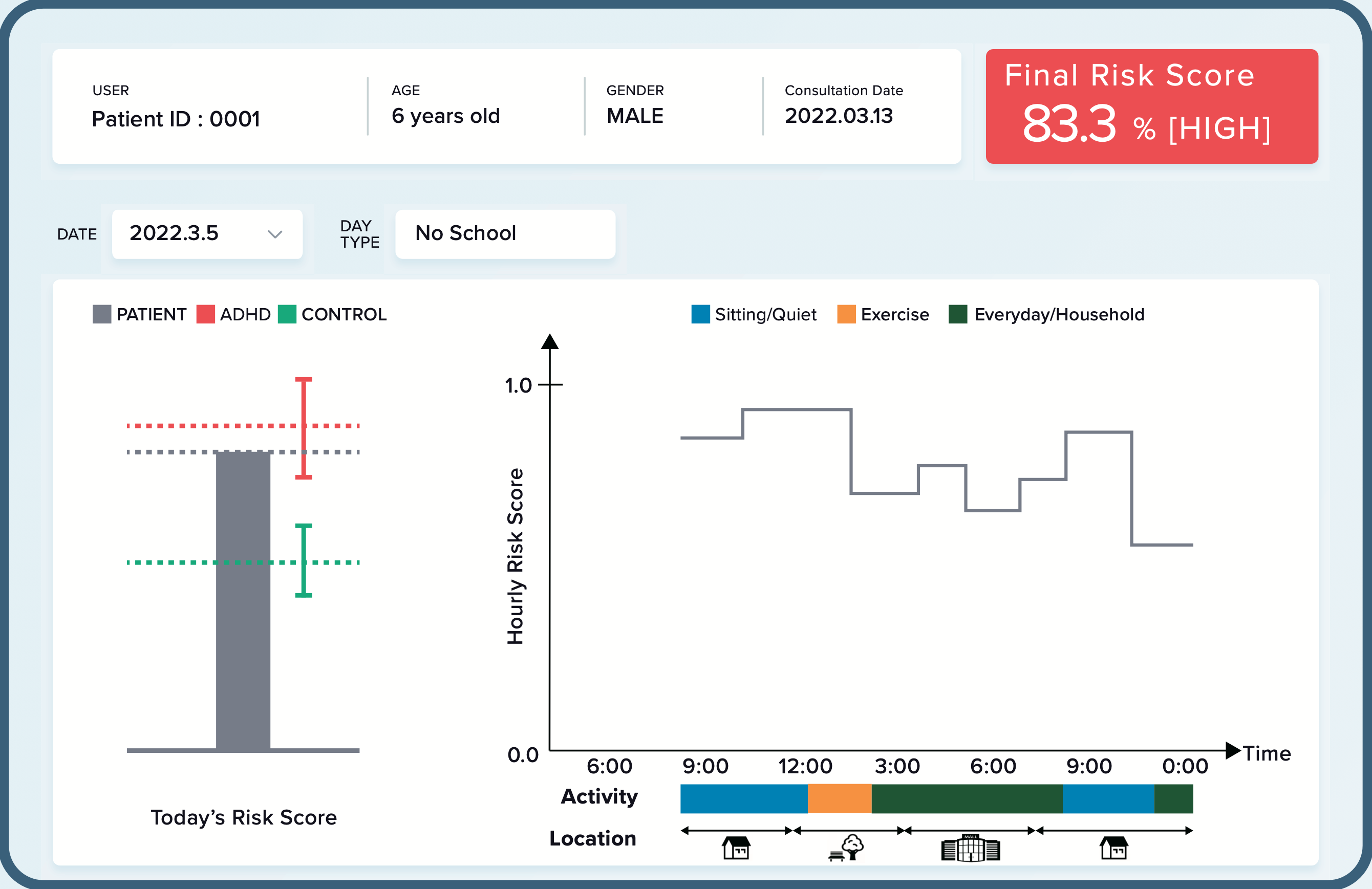
This context-aware approach improved the accuracy of distinguishing children with and without hyperactivity from 67.2% to 82.0%. Building on this pipeline, we extended the model to produce a real-time hyperactivity estimate from a window as short as 30 minutes, enabling the interventions described below. We are also exploring clinician-facing interfaces that visualize these signals to support diagnosis and longitudinal monitoring.
Intervention Approach
While objective measurement is valuable for diagnosis, caregivers also need support throughout everyday life. To explore this opportunity, we developed [C.25] CalmReminder, a sensing-based intervention system that builds on the LemurDx sensing pipeline.
Even 82.0% accuracy is insufficient for autonomous clinical judgment, and notifying caregivers of every predicted hyperactive moment could interrupt families and heighten worry when the sensing is wrong. Therefore, in collaboration with experienced psychologists and pediatricians, we designed CalmReminder to instead surface likely calm moments detected from the child's smartwatch. These positive, low-burden prompts help caregivers notice what is already working and reinforce positive behavior, and they remain useful even when sensing errs because they direct attention without presenting predictions as clinical assessments.
We deployed CalmReminder as a design probe with 16 families over four weeks, which revealed two complementary forms of adaptation. First, the system adapts to the caregiver: caregivers provide lightweight feedback on whether each detected moment was actually calm, allowing the model to learn each child's behavioral baseline and improving calm-moment detection from 39% to 78%. Second, the caregiver adapts to the system: while some caregivers used the prompts for positive reinforcement as designed, others appropriated them as mindfulness or reflection reminders, or as conversation starters with their child.
Looking Forward & Impact
These findings suggest that reliable long-term assistants should not only personalize their underlying models, but also allow users and AI to co-adapt how, when, and for what purposes assistance is used.
LemurDx has been deployed with UPMC for the past five years, reaching more than 100 patients to date, and is progressing toward commercial translation with funding from the National Institute of Mental Health (NIMH). These longitudinal deployments now enable us to study how human–AI co-adaptation unfolds over time and whether it leads to measurable improvements in clinical outcomes.
Acknowledgments
We thank Sam Shaaban from NuRelm, Inc. and his team for their support in advancing the deployment of our system.
Links
Research Publications
- [C.25] CalmReminder: A Design Probe for Parental Engagement with Children with Hyperactivity, Augmented by Real-Time Motion Sensing with a Watch, CHI2026
- [J.5] LemurDx: Using Unconstrained Passive Sensing for an Objective Measurement of Hyperactivity in Children with no Parent Input, IMWUT2023